<?xml version="1.0" encoding="utf-8"?><feed xmlns="http://www.w3.org/2005/Atom" ><generator uri="https://jekyllrb.com/" version="3.9.5">Jekyll</generator><link href="https://geosx.github.io/feed.xml" rel="self" type="application/atom+xml" /><link href="https://geosx.github.io/" rel="alternate" type="text/html" /><updated>2024-02-16T22:17:15+00:00</updated><id>https://geosx.github.io/feed.xml</id><title type="html">GEOS</title><subtitle>GEOS Simulation Framework</subtitle><entry><title type="html">Simulation of coupled multiphase flow and geomechanics in porous media with embedded discrete fractures</title><link href="https://geosx.github.io/publications/2020/12/05/cusini-ijnamg.html" rel="alternate" type="text/html" title="Simulation of coupled multiphase flow and geomechanics in porous media with embedded discrete fractures" /><published>2020-12-05T19:00:01+00:00</published><updated>2020-12-05T19:00:01+00:00</updated><id>https://geosx.github.io/publications/2020/12/05/cusini-ijnamg</id><content type="html" xml:base="https://geosx.github.io/publications/2020/12/05/cusini-ijnamg.html"><![CDATA[<p><em>Matteo Cusini, Joshua A. White, Nicola Castelletto, and Randolph R. Settgast</em></p>

<p>International Journal for Numerical and Analytical Methods in Geomechanics</p>

<p><strong>Abstract</strong></p>

<p>In fractured natural formations, the equations governing fluid flow and geomechanics are strongly coupled. Hydrodynamical properties depend on the mechanical configuration, and they are therefore difficult to accurately resolve using uncoupled methods. In recent years, significant research has focused on discretization strategies for these coupled systems, particularly in the presence of complicated fracture network geometries. In this work, we explore a finite-volume discretization for the multiphase flow equations coupled with a finite-element scheme for the mechanical equations. Fractures are treated as lower dimensional surfaces embedded in a background grid. Interactions are captured using the Embedded Discrete Fracture Model (EDFM) and the Embedded Finite Element Method (EFEM) for the flow and the mechanics, respectively. This non-conforming approach significantly alleviates meshing challenges. EDFM considers fractures as lower dimension finiten volumes which exchange fluxes with the rock matrix cells. The EFEM method provides, instead, a local enrichment of the finite-element space inside each matrix cell cut by a fracture element. Both the use of piecewise constant and piecewise linear enrichments are investigated. They are also compared to an Extended Finite Element (XFEM) approach. One key advantage of EFEM is the element-based nature of the enrichment, which reduces the geometric complexity of the implementation and leads to linear systems with advantageous properties. Synthetic numerical tests are presented to study the convergence and accuracy of the proposed method. It is also applied to a realistic scenario, involving a heterogeneous reservoir with a complex fracture distribution, to demonstrate its relevance for field applications.</p>

<p><strong>Link to Full Paper</strong></p>

<p><a href="https://doi.org/10.1002/nag.3168">https://doi.org/10.1002/nag.3168</a></p>

<p><strong>Highlight</strong></p>

<figure class=" ">
  
    
      <img src="/assets/images/highlights/2020-12-05-cusini-ijnamg.png" alt="highlight image" />


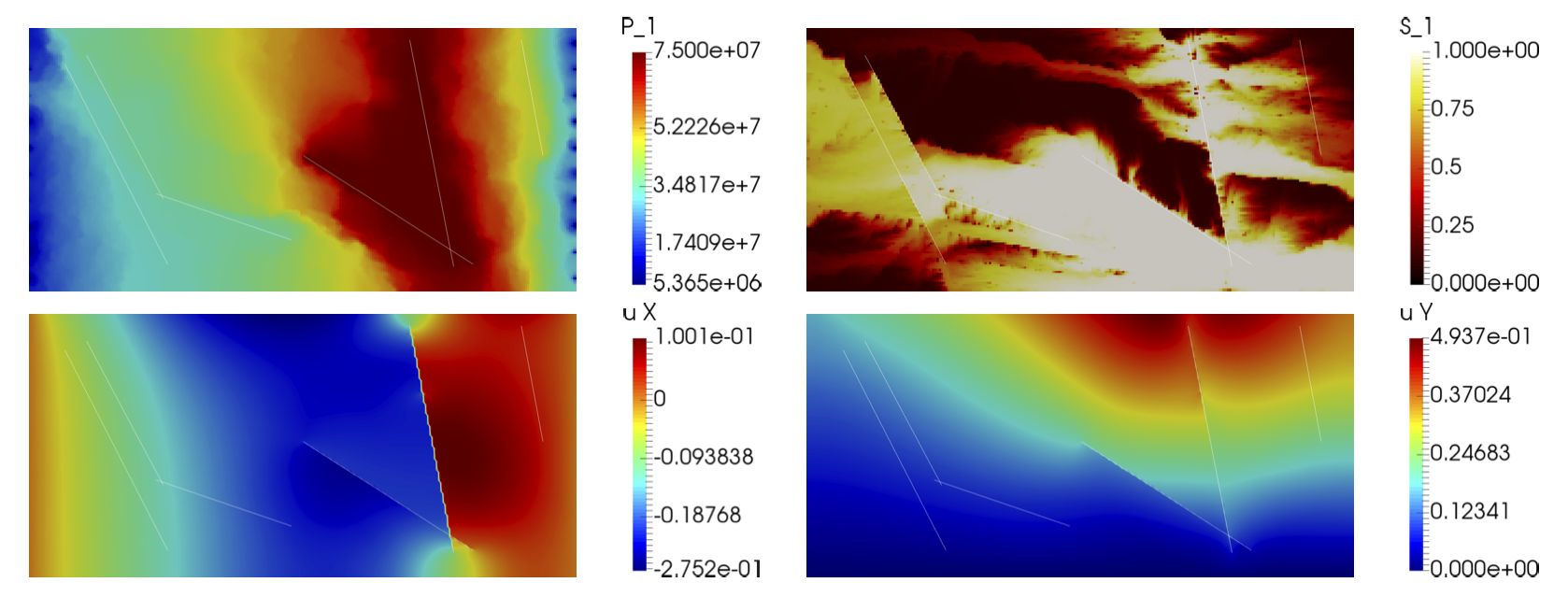
    <figcaption>Simulation of water flooding in a fractured reservoir, showing pressure (upper left), saturation (upper right), horizontal displacement (lower left), and vertical displacement (upper right).  The fractures are treated as lower dimensional surfaces embedded in a background mesh, simplifying mesh construction.  All mechanical and flow fields are solved in a fully-coupled manner.
</figcaption>
  
</figure>]]></content><author><name>Matteo Cusini</name></author><category term="publications" /><summary type="html"><![CDATA[Matteo Cusini, Joshua A. White, Nicola Castelletto, and Randolph R. Settgast]]></summary></entry><entry><title type="html">An anisotropic viscoplasticity model for shale based on layered microstructure homogenization</title><link href="https://geosx.github.io/publications/2020/12/03/choo-ijnamg.html" rel="alternate" type="text/html" title="An anisotropic viscoplasticity model for shale based on layered microstructure homogenization" /><published>2020-12-03T19:00:00+00:00</published><updated>2020-12-03T19:00:00+00:00</updated><id>https://geosx.github.io/publications/2020/12/03/choo-ijnamg</id><content type="html" xml:base="https://geosx.github.io/publications/2020/12/03/choo-ijnamg.html"><![CDATA[<p><em>Jinhyun Choo, Shabnam J. Semnani, and Joshua A. White</em></p>

<p>International Journal for Numerical and Analytical Methods in Geomechanics</p>

<p><strong>Abstract</strong></p>

<p>Viscoplastic deformation of shale is frequently observed in many subsurface applications. Many studies have suggested that this viscoplastic behavior is anisotropic—specifically, transversely isotropic—and closely linked to the layered composite structure at the microscale. In this work, we develop a two‐scale constitutive model for shale in which anisotropic viscoplastic behavior naturally emerges from semianalytical homogenization of a bilayer microstructure. The microstructure is modeled as a composite of soft layers, representing a ductile matrix formed by clay and organics, and hard layers, corresponding to a brittle matrix composed of stiff minerals. This layered microstructure renders the macroscopic behavior anisotropic, even when the individual layers are modeled with isotropic constitutive laws. Using a common correlation between clay and organic content and magnitude of creep, we apply a viscoplastic modified Cam‐Clay plasticity model to the soft layers, while treating the hard layers as a linear elastic material to minimize the number of calibration parameters. We then describe the implementation of the proposed model in a standard material update subroutine. The model is validated with laboratory creep data on samples from three gas shale formations. We also demonstrate the computational behavior of the proposed model through simulation of time‐dependent borehole closure in a shale formation with different bedding plane directions.</p>

<p><strong>Link to Full Paper</strong></p>

<p><a href="https://doi.org/10.1002/nag.3167">https://doi.org/10.1002/nag.3167</a></p>

<p><strong>Highlight</strong></p>

<figure class=" ">
  
    
      <img src="/assets/images/highlights/2020-12-03-choo-ijnamg.png" alt="highlight image" />


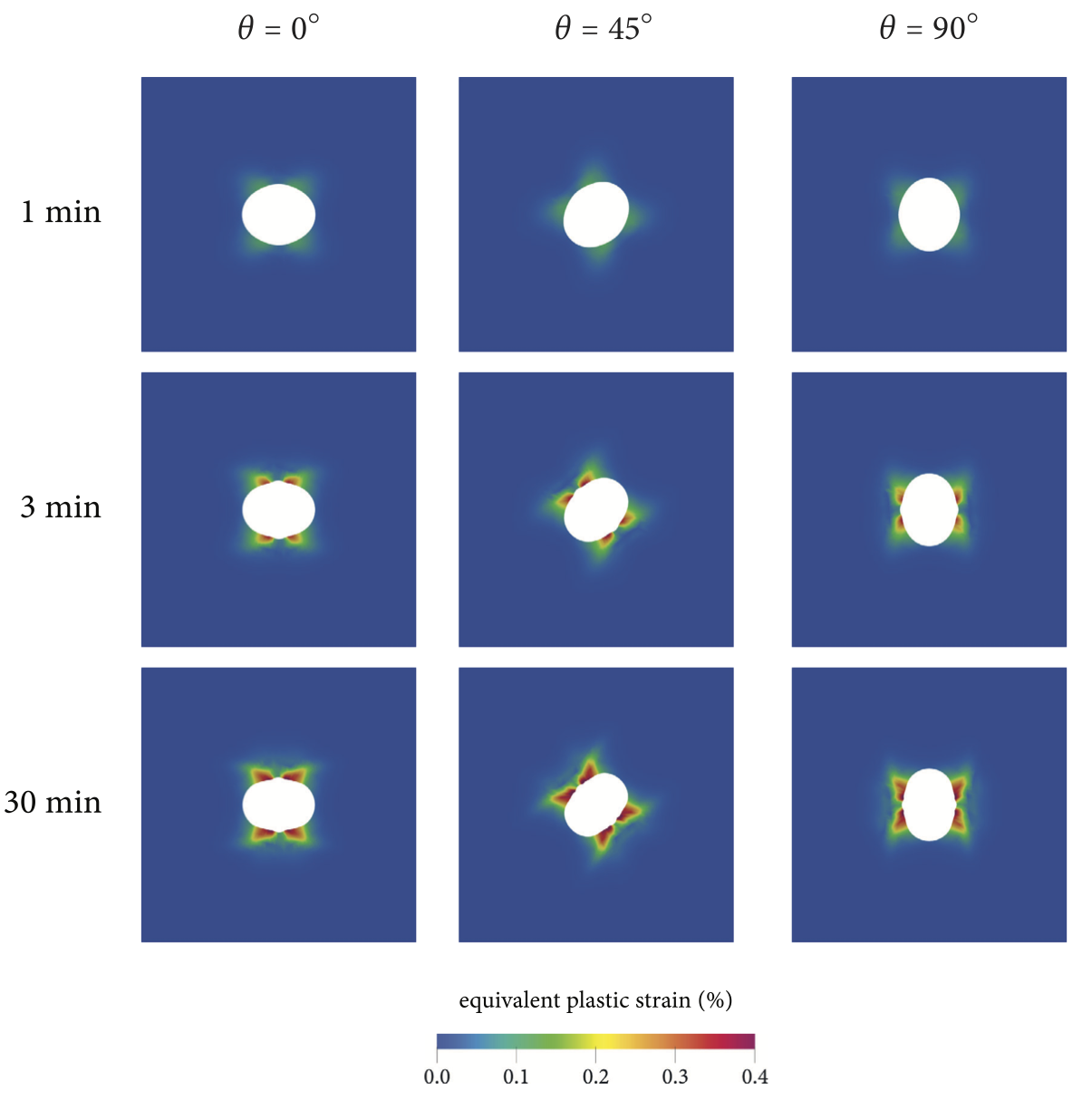
    <figcaption>Simulation of creep closure of a horizontal borehole in a layered shale.  Each column corresponds to different bedding plane orientations with respect to horizontal, while each row provides snapshots of the plastic strain evolution at increasing times.  The proposed material model is able to capture both the impact of anisotropy and time-dependent creep.
</figcaption>
  
</figure>]]></content><author><name>Jinhyun Choo</name></author><category term="publications" /><summary type="html"><![CDATA[Jinhyun Choo, Shabnam J. Semnani, and Joshua A. White]]></summary></entry><entry><title type="html">Nonlinear multigrid based on local spectral coarsening for heterogeneous diffusion problems</title><link href="https://geosx.github.io/publications/2020/12/01/lee-cmame.html" rel="alternate" type="text/html" title="Nonlinear multigrid based on local spectral coarsening for heterogeneous diffusion problems" /><published>2020-12-01T19:00:00+00:00</published><updated>2020-12-01T19:00:00+00:00</updated><id>https://geosx.github.io/publications/2020/12/01/lee-cmame</id><content type="html" xml:base="https://geosx.github.io/publications/2020/12/01/lee-cmame.html"><![CDATA[<p><em>Chak S. Lee, François Hamon, Nicola Castelletto, Panayot S. Vassilevski, Joshua A. White</em></p>

<p>Computer Methods in Applied Mechanics and Engineering</p>

<p><strong>Abstract</strong></p>

<p>This work develops a nonlinear multigrid method for diffusion problems discretized by cell-centered finite volume methods on general unstructured grids. The multigrid hierarchy is constructed algebraically using aggregation of degrees of freedom and spectral decomposition of reference linear operators associated with the aggregates. For rapid convergence, it is important that the resulting coarse spaces have good approximation properties. In our approach, the approximation quality can be directly improved by including more spectral degrees of freedom in the coarsening process. Further, by exploiting local coarsening and a piecewise-constant approximation when evaluating the nonlinear component, the coarse level problems are assembled and solved without ever re-visiting the fine level, an essential element for multigrid algorithms to achieve optimal scalability. Numerical examples comparing relative performance of the proposed nonlinear multigrid solvers with standard single-level approaches – Picard’s and Newton’s methods – are presented. Results show that the proposed solver consistently outperforms the single-level methods, both in efficiency and robustness.</p>

<p><strong>Link to Full Paper</strong></p>

<p><a href="https://doi.org/10.1016/j.cma.2020.113432">https://doi.org/10.1016/j.cma.2020.113432</a></p>

<p><strong>Highlight</strong></p>

<figure class=" ">
  
    
      <img src="/assets/images/highlights/2020-12-01-lee-cmame.png" alt="highlight image" />


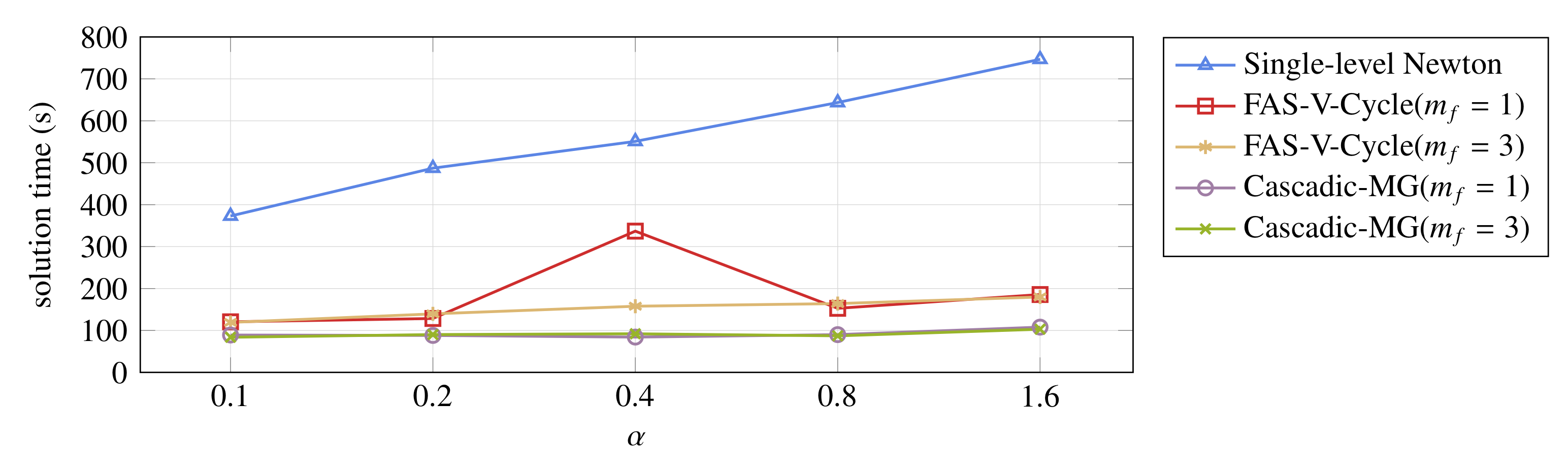
    <figcaption>Comparison of the overall solution time of single-level Newton vs. several nonlinear multigrid variants for a nonlinear diffusion problem.  The parameter alpha controls the nonlinearity of the permeability function.  We see the proposed schemes can substantially outperform the classical Newton’s method.
</figcaption>
  
</figure>]]></content><author><name>Chak Lee</name></author><category term="publications" /><summary type="html"><![CDATA[Chak S. Lee, François Hamon, Nicola Castelletto, Panayot S. Vassilevski, Joshua A. White]]></summary></entry><entry><title type="html">Enhanced multiscale restriction-smoothed basis (MsRSB) preconditioning with applications to porous media flow and geomechanics</title><link href="https://geosx.github.io/publications/2020/10/21/bosma-jcp.html" rel="alternate" type="text/html" title="Enhanced multiscale restriction-smoothed basis (MsRSB) preconditioning with applications to porous media flow and geomechanics" /><published>2020-10-21T19:00:00+00:00</published><updated>2020-10-21T19:00:00+00:00</updated><id>https://geosx.github.io/publications/2020/10/21/bosma-jcp</id><content type="html" xml:base="https://geosx.github.io/publications/2020/10/21/bosma-jcp.html"><![CDATA[<p><em>Sebastian B. M. Bosma, Sergey Klevtsov, Olav Møyner, Nicola Castelletto</em></p>

<p>Journal of Computational Physics</p>

<p><strong>Abstract</strong></p>

<p>A novel multiscale method for non M-matrices using Multiscale Restricted Smoothed Basis (MsRSB) functions is presented. The original MsRSB method is enhanced with a filtering strategy enforcing M-matrix properties to enable the robust application of MsRSB as a preconditioner. Through applications to porous media flow and linear elastic geomechanics, the method is proven to be effective for scalar and vector problems with multipoint finite volume (FV) and finite element (FE) discretization schemes, respectively. Realistic complex (un)structured two- and three-dimensional test cases are considered to illustrate the method’s performance.</p>

<p><strong>Link to Full Paper</strong></p>

<p><a href="https://doi.org/10.1016/j.jcp.2020.109934">https://doi.org/10.1016/j.jcp.2020.109934</a></p>

<p><strong>Highlight</strong></p>

<figure class=" ">
  
    
      <img src="/assets/images/highlights/2020-10-21-bosma-jcp.png" alt="highlight image" />


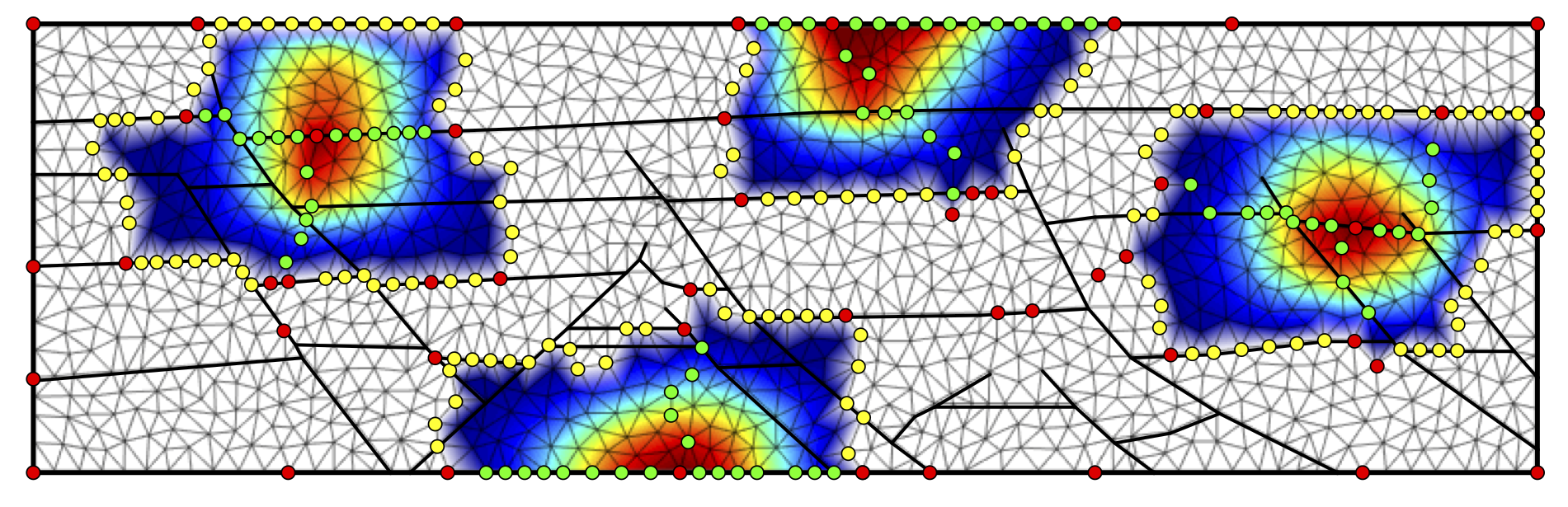
    <figcaption>MsRSB provides a flexible strategy to compute multiscale basis functions in realistic, unstructured settings.  Here, we see several example basis functions for elasticity in a highly faulted reservoir.
</figcaption>
  
</figure>]]></content><author><name>Bosma</name></author><category term="publications" /><summary type="html"><![CDATA[Sebastian B. M. Bosma, Sergey Klevtsov, Olav Møyner, Nicola Castelletto]]></summary></entry><entry><title type="html">Efficient solvers for hybridized three-field mixed finite element coupled poromechanics</title><link href="https://geosx.github.io/publications/2020/08/06/frigo-camwa.html" rel="alternate" type="text/html" title="Efficient solvers for hybridized three-field mixed finite element coupled poromechanics" /><published>2020-08-06T19:00:00+00:00</published><updated>2020-08-06T19:00:00+00:00</updated><id>https://geosx.github.io/publications/2020/08/06/frigo-camwa</id><content type="html" xml:base="https://geosx.github.io/publications/2020/08/06/frigo-camwa.html"><![CDATA[<p><em>Matteo Frigo, Nicola Castelletto, Massimiliano Ferronato, Joshua A. White</em></p>

<p>Computers and Mathematics with Applications</p>

<p><strong>Abstract</strong></p>

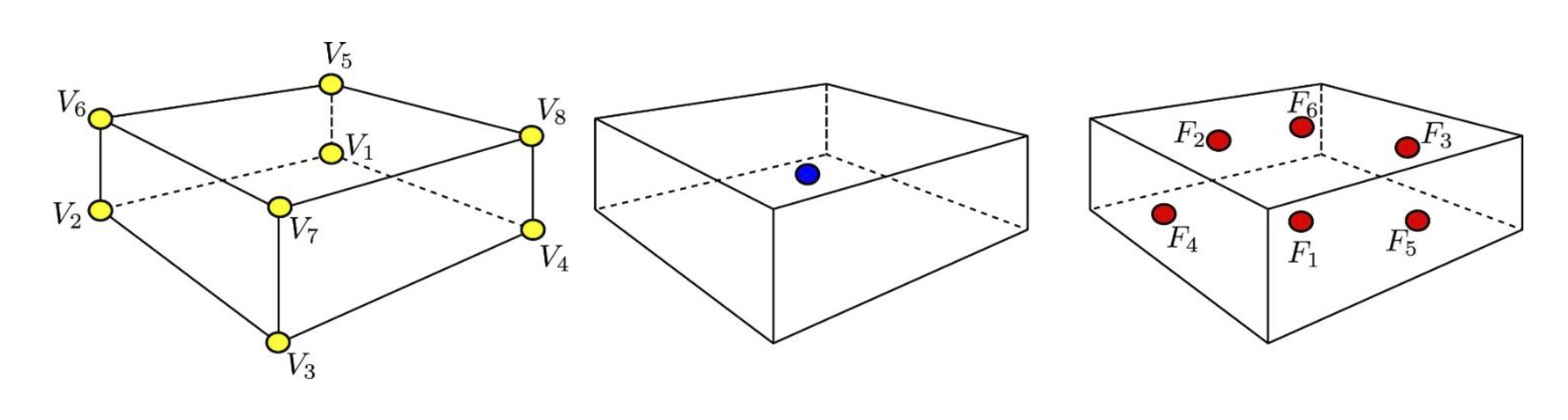
<p>We consider a mixed hybrid finite element formulation for coupled poromechanics. A stabilization strategy based on a macro-element approach is advanced to eliminate the spurious pressure modes appearing in undrained/incompressible conditions. The efficient solution of the stabilized mixed hybrid block system is addressed by developing a class of block triangular preconditioners based on a Schur-complement approximation strategy. Robustness, computational efficiency and scalability of the proposed approach are theoretically discussed and tested using challenging benchmark problems on massively parallel architectures.</p>

<p><strong>Link to Full Paper</strong></p>

<p><a href="https://doi.org/10.1016/j.camwa.2020.07.010">https://doi.org/10.1016/j.camwa.2020.07.010</a></p>

<p><strong>Highlight</strong></p>

<figure class=" ">
  
    
      <img src="/assets/images/highlights/2020-08-06-frigo-camwa.png" alt="highlight image" />


    <figcaption>In this work, we explore efficient solvers for mixed hybrid finite element formulations of poroelasticity, involving vertex, cell, and face-centered degrees of freedom.
</figcaption>
  
</figure>]]></content><author><name>Matteo Frigo</name></author><category term="publications" /><summary type="html"><![CDATA[Matteo Frigo, Nicola Castelletto, Massimiliano Ferronato, Joshua A. White]]></summary></entry><entry><title type="html">An inelastic homogenization framework for layered materials with planes of weakness</title><link href="https://geosx.github.io/publications/2020/07/13/semnani-cmame.html" rel="alternate" type="text/html" title="An inelastic homogenization framework for layered materials with planes of weakness" /><published>2020-07-13T19:00:00+00:00</published><updated>2020-07-13T19:00:00+00:00</updated><id>https://geosx.github.io/publications/2020/07/13/semnani-cmame</id><content type="html" xml:base="https://geosx.github.io/publications/2020/07/13/semnani-cmame.html"><![CDATA[<p><em>Shabnam J. Semnani and Joshua A. White</em></p>

<p>Computer Methods in Applied Mechanics and Engineering</p>

<p><strong>Abstract</strong></p>

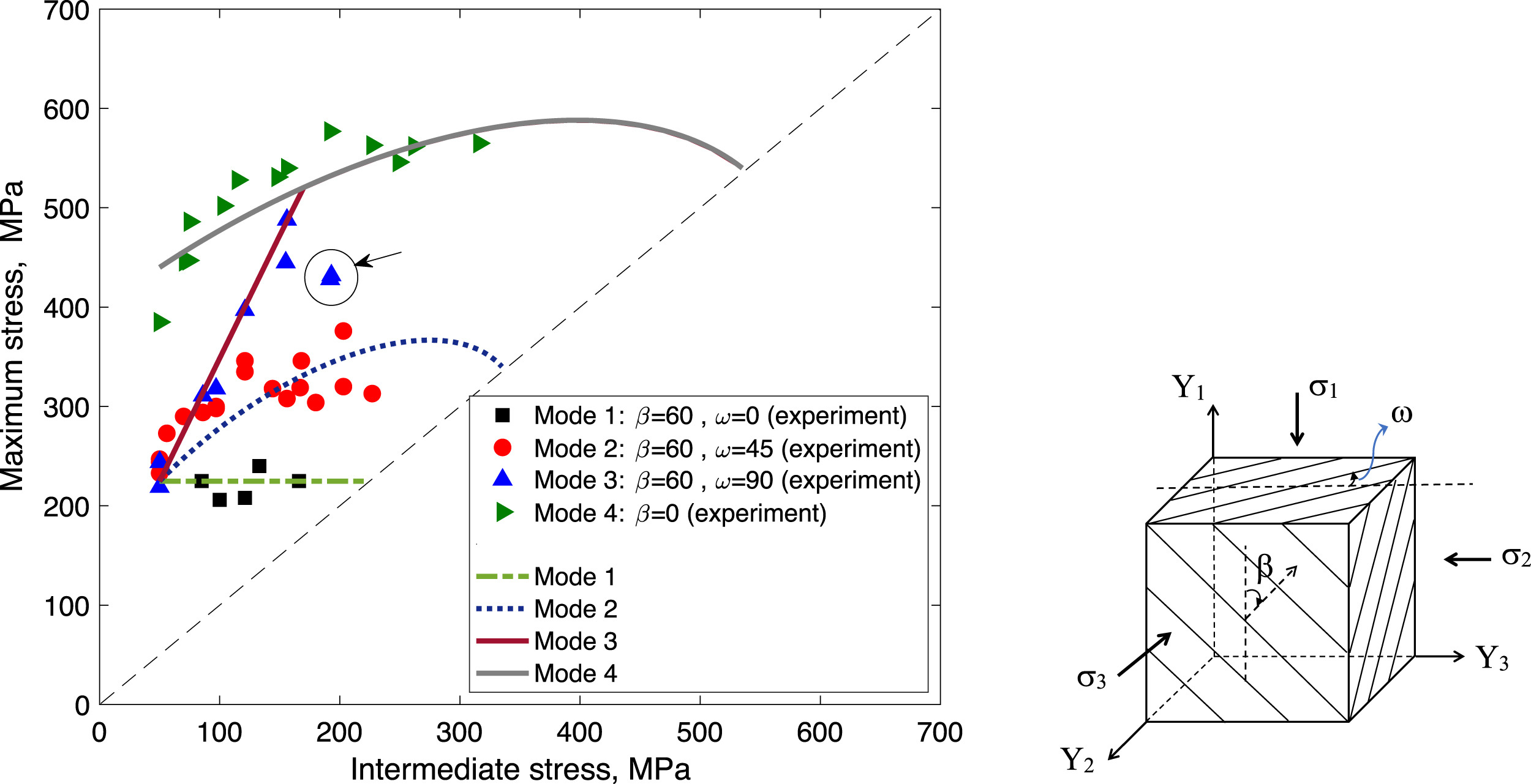
<p>Many geologic materials have a composite structure, in which macroscopic mechanical behavior is determined by the properties, shape, and heterogeneous distribution of individual constituents. In particular, sedimentary rocks commonly exhibit a layered microstructure, with distinct bedding planes that can also form planes of weakness. In this work, we present a homogenization framework for modeling inelastic layered media. The proposed constitutive model allows for distinct micro-constitutive laws for each layer, explicit representation of layer distributions, as well as incorporation of imperfect bonding at the interface between adjacent layers. No a priori assumptions are needed regarding the specific constitutive models used for the layers and interfaces, providing significant modeling flexibility. The overall framework provides a simple and physically-motivated way of defining anisotropic material behavior as an emergent property of the layered microstructure. The model is calibrated using triaxial and true-triaxial experimental data to demonstrate its ability to describe anisotropic deformation and multiple modes of failure.</p>

<p><strong>Link to Full Paper</strong></p>

<p><a href="https://doi.org/10.1016/j.cma.2020.113221">https://doi.org/10.1016/j.cma.2020.113221</a></p>

<p><strong>Highlight</strong></p>

<figure class=" ">
  
    
      <img src="/assets/images/highlights/2020-07-13-semnani-cmame.jpg" alt="highlight image" />


    <figcaption>Comparison of model predictions with true triaxial  test  data  from  Mogi [RMRE 1979] for Chichibu schist.  This metamorphic crystalline rock has a densely foliated structure, leading to different failure modes depending on the stress and loading orientation.  Here, a constitutive framework is proposed to capture anistropy, plasticity, and discrete interface sliding inherent in such layered materials.
</figcaption>
  
</figure>]]></content><author><name>Shabnam Semnani</name></author><category term="publications" /><summary type="html"><![CDATA[Shabnam J. Semnani and Joshua A. White]]></summary></entry><entry><title type="html">A macroelement stabilization for mixed finite element/finite volume discretizations of multiphase poromechanics</title><link href="https://geosx.github.io/publications/2020/06/11/camargo-compgeo.html" rel="alternate" type="text/html" title="A macroelement stabilization for mixed finite element/finite volume discretizations of multiphase poromechanics" /><published>2020-06-11T19:00:00+00:00</published><updated>2020-06-11T19:00:00+00:00</updated><id>https://geosx.github.io/publications/2020/06/11/camargo-compgeo</id><content type="html" xml:base="https://geosx.github.io/publications/2020/06/11/camargo-compgeo.html"><![CDATA[<p><em>Julia T. Camargo, Joshua A. White, and Ronaldo I. Borja</em></p>

<p>Computational Geosciences</p>

<p><strong>Abstract</strong></p>

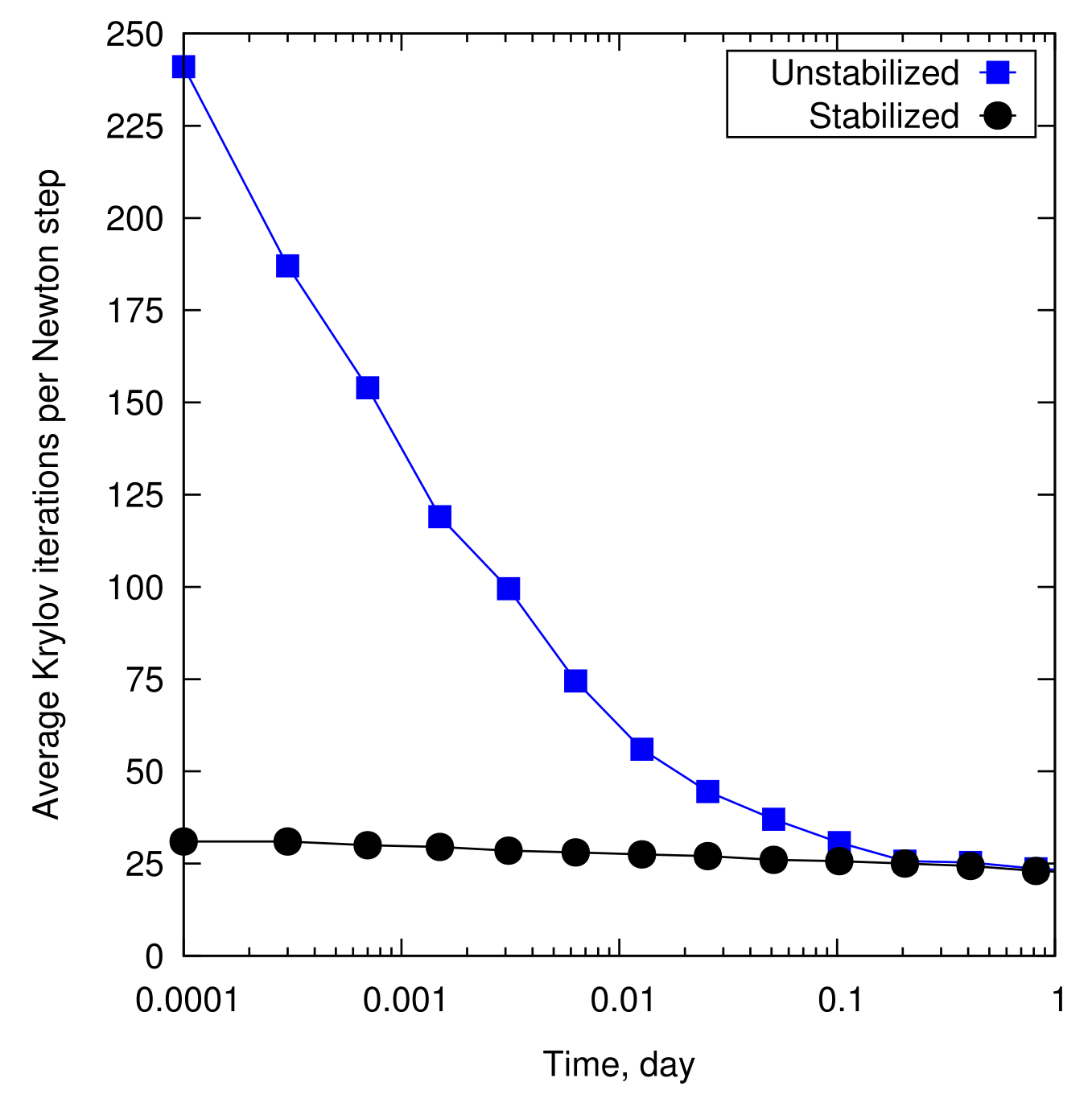
<p>Strong coupling between geomechanical deformation and multiphase fluid flow appears in a variety of geoscience applications. A common discretization strategy for these problems is a continuous Galerkin finite element scheme for the momentum balance equation and a finite volume scheme for the mass balance equations. When applied within a fully implicit solution strategy, however, this discretization is not intrinsically stable. In the limit of small time steps or low permeabilities, spurious oscillations in the piecewise-constant pressure field, i.e., checkerboarding, may be observed. Further, eigenvalues associated with the spurious modes will control the conditioning of the matrices and can dramatically degrade the convergence rate of iterative linear solvers. Here, we propose a stabilization technique in which the mass balance equations are supplemented with stabilizing flux terms on a macroelement basis. The additional stabilization terms are dependent on a stabilization parameter. We identify an optimal value for this parameter using an analysis of the eigenvalue distribution of the macroelement Schur complement matrix. The resulting method is simple to implement and preserves the underlying sparsity pattern of the original discretization. Another appealing feature of the method is that mass is exactly conserved on macroelements, despite the addition of artificial fluxes. The efficacy of the proposed technique is demonstrated with several numerical examples.</p>

<p><strong>Link to Full Paper</strong></p>

<p><a href="https://doi.org/10.1007/s10596-020-09964-3">https://doi.org/10.1007/s10596-020-09964-3</a></p>

<p><strong>Highlight</strong></p>

<figure class=" ">
  
    
      <img src="/assets/images/highlights/2020-06-11-carmargo-compgeo.png" alt="highlight image" />


    <figcaption>The standard mixed finite-element/finite volume scheme is intrinsically unstable, leading to near-singular matrices for either small timesteps or low permeabilities.  This can have a substantial impact on linear solver convergence.  Here, we see the proposed stabilization dramatically reduces the number of linear iterations needed to converge.
</figcaption>
  
</figure>]]></content><author><name>Julia de Toledo Camargo</name></author><category term="publications" /><summary type="html"><![CDATA[Julia T. Camargo, Joshua A. White, and Ronaldo I. Borja]]></summary></entry><entry><title type="html">Multi-stage preconditioners for thermal–compositional–reactive flow in porous media</title><link href="https://geosx.github.io/publications/2020/05/29/cremon-jcp.html" rel="alternate" type="text/html" title="Multi-stage preconditioners for thermal–compositional–reactive flow in porous media" /><published>2020-05-29T19:00:00+00:00</published><updated>2020-05-29T19:00:00+00:00</updated><id>https://geosx.github.io/publications/2020/05/29/cremon-jcp</id><content type="html" xml:base="https://geosx.github.io/publications/2020/05/29/cremon-jcp.html"><![CDATA[<p><em>Matthias A. Cremon, Nicola Castelletto, and Joshua A. White</em></p>

<p>Journal of Computational Physics</p>

<p><strong>Abstract</strong></p>

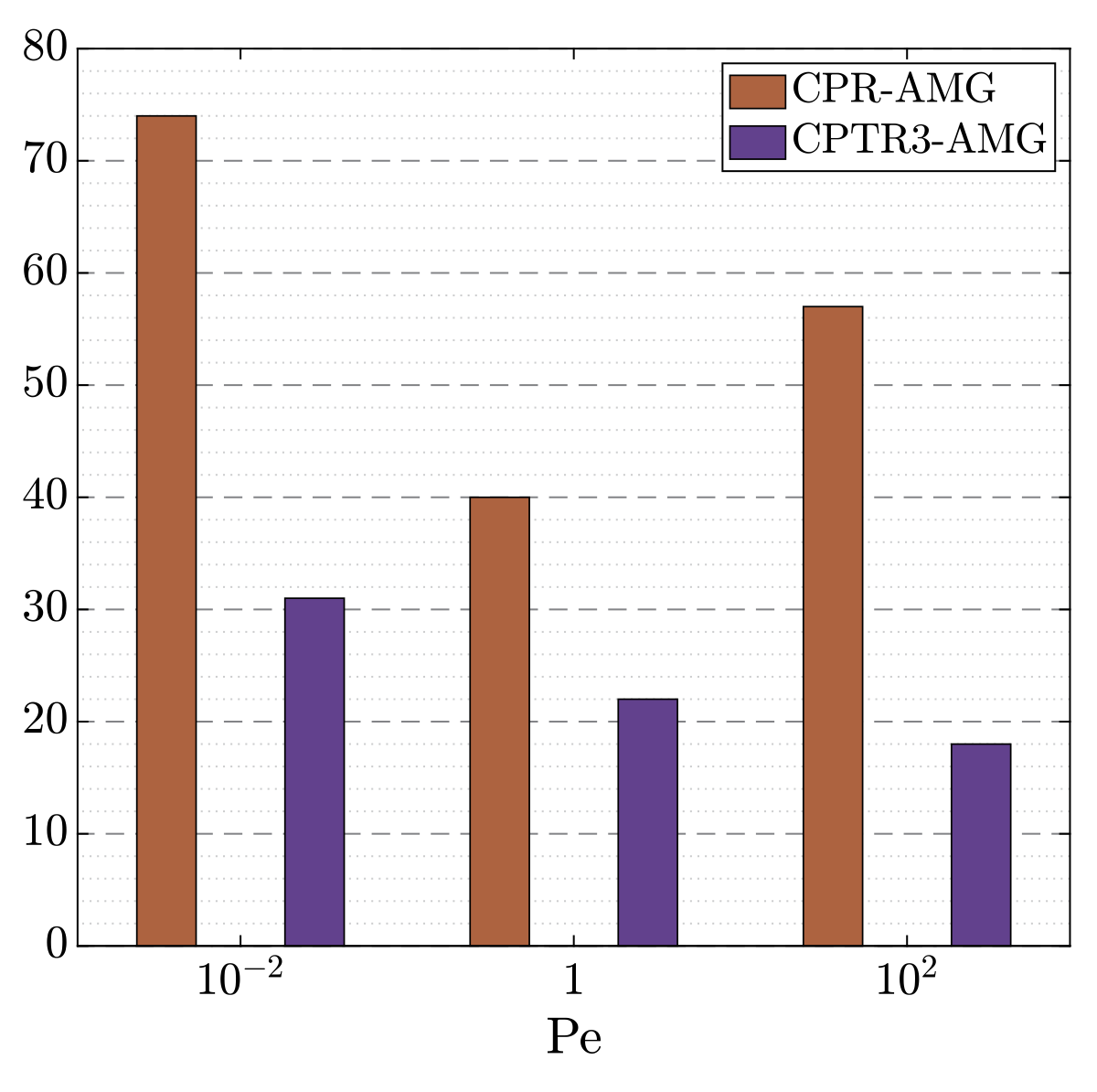
<p>We present a family of multi-stage preconditioners for coupled thermal-compositional-reactive reservoir simulation problems. The most common preconditioner used in industrial practice, the Constrained Pressure Residual (CPR) method, was designed for isothermal models and does not offer a specific strategy for the energy equation. For thermal simulations, inadequate treatment of the temperature unknown can cause severe convergence degradation. When strong thermal diffusion is present, the energy equation exhibits significant elliptic behavior that cannot be accurately corrected by CPR’s second stage. In this work, we use Schur-complement decompositions to extract a temperature subsystem and apply an Algebraic MultiGrid (AMG) approximation as an additional preconditioning stage to improve the treatment of the energy equation. We present results for several two-dimensional hot air injection problems using an extra heavy oil, including challenging reactive In-Situ Combustion (ISC) cases. We show improved performance and robustness across different thermal regimes, from advection dominated (high Péclet number) to diffusion dominated (low Péclet number). The number of linear iterations is reduced by 40–85% compared to standard CPR for both homogeneous and heterogeneous media, and the new methods exhibit almost no sensitivity to the thermal regime.</p>

<p><strong>Link to Full Paper</strong></p>

<p><a href="https://doi.org/10.1016/j.jcp.2020.109607">https://doi.org/10.1016/j.jcp.2020.109607</a></p>

<p><strong>Highlight</strong></p>

<figure class=" ">
  
    
      <img src="/assets/images/highlights/2020-05-29-cremon-jcp.png" alt="highlight image" />


    <figcaption>In this work, we propose a preconditioning strategy (CPTR3) that substantially outperforms traditional CPR when applied to thermal simulations across a range of Peclet numbers. Vertical axis is GMRES iterations to convergence.
</figcaption>
  
</figure>]]></content><author><name>Matthias Cremon</name></author><category term="publications" /><summary type="html"><![CDATA[Matthias A. Cremon, Nicola Castelletto, and Joshua A. White]]></summary></entry><entry><title type="html">Algebraically stabilized Lagrange multiplier method for frictional contact mechanics with hydraulically active fractures</title><link href="https://geosx.github.io/publications/2020/04/15/franceschini-cmame.html" rel="alternate" type="text/html" title="Algebraically stabilized Lagrange multiplier method for frictional contact mechanics with hydraulically active fractures" /><published>2020-04-15T19:00:00+00:00</published><updated>2020-04-15T19:00:00+00:00</updated><id>https://geosx.github.io/publications/2020/04/15/franceschini-cmame</id><content type="html" xml:base="https://geosx.github.io/publications/2020/04/15/franceschini-cmame.html"><![CDATA[<p><em>Andrea Franceschini, Nicola Castelletto, Joshua A. White, and Hamdi A. Tchelepi</em></p>

<p>Computer Methods in Applied Mechanics and Engineering</p>

<p><strong>Abstract</strong></p>

<p>Accurate numerical simulation of coupled fracture/fault deformation and fluid flow is crucial to the performance and safety assessment of many subsurface systems. In this work, we consider the discretization and enforcement of contact conditions at such surfaces. The bulk rock deformation is simulated using low-order continuous finite elements, while frictional contact conditions are imposed by means of a Lagrange multiplier method. We employ a cell-centered finite-volume scheme to solve the fracture fluid mass balance equation. From a modeling perspective, a convenient choice is to use a single grid for both mechanical and flow processes, with piecewise-constant interpolation of Lagrange multipliers, i.e., contact tractions and fluid pressure. Unfortunately, this combination of displacement and multiplier variables is not uniformly inf–sup stable, and therefore requires a stabilization technique. Starting from a macroelement analysis, we develop two algebraic stabilization approaches and compare them in terms of robustness and convergence rate. The proposed approaches are validated against challenging analytical two- and three-dimensional benchmarks to demonstrate accuracy and robustness. These benchmarks include both pure contact mechanics problems and well as problems with tightly-coupled fracture flow.</p>

<p><strong>Link to Full Paper</strong></p>

<p><a href="https://doi.org/10.1016/j.cma.2020.113161">https://doi.org/10.1016/j.cma.2020.113161</a></p>

<p><strong>Highlight</strong></p>

<figure class=" ">
  
    
      <img src="/assets/images/highlights/2020-04-15-franceschini-cmame.png" alt="highlight image" />


    <figcaption>A simple example of frictional sliding between two surfaces.  Using a piecewise constant Lagrange multiplier interpolation, the resulting traction field would show severe oscillations.  With stabilization, a smooth and accurate solution is recovered.
</figcaption>
  
</figure>]]></content><author><name>Andrea Franceschini</name></author><category term="publications" /><summary type="html"><![CDATA[Andrea Franceschini, Nicola Castelletto, Joshua A. White, and Hamdi A. Tchelepi]]></summary></entry><entry><title type="html">A scalable multigrid reduction framework for multiphase poromechanics of heterogeneous media</title><link href="https://geosx.github.io/publications/2020/03/12/bui-sisc.html" rel="alternate" type="text/html" title="A scalable multigrid reduction framework for multiphase poromechanics of heterogeneous media" /><published>2020-03-12T19:00:00+00:00</published><updated>2020-03-12T19:00:00+00:00</updated><id>https://geosx.github.io/publications/2020/03/12/bui-sisc</id><content type="html" xml:base="https://geosx.github.io/publications/2020/03/12/bui-sisc.html"><![CDATA[<p><em>Quan M. Bui, Daniel Osei-Kuffuor, Nicola Castelletto, and Joshua A. White</em></p>

<p>SIAM Journal of Scientific Computing</p>

<p><strong>Abstract</strong></p>

<p>Simulation of multiphase poromechanics involves solving a multiphysics problem in which multiphase flow and transport are tightly coupled with the porous medium deformation. To capture this dynamic interplay, fully implicit methods, also known as monolithic approaches, are usually preferred. The main bottleneck of a monolithic approach is that it requires solution of large linear systems that result from the discretization and linearization of the governing balance equations. Because such systems are nonsymmetric, indefinite, and highly ill-conditioned, preconditioning is critical for fast convergence. Recently, most efforts in designing efficient preconditioners for multiphase poromechanics have been dominated by physics-based strategies. Current state-of-the-art “black-box” solvers such as algebraic multigrid (AMG) are ineffective because they cannot effectively capture the strong coupling between the mechanics and the flow subproblems, as well as the coupling inherent in the multiphase flow and transport process. In this work, we develop an algebraic framework based on multigrid reduction (MGR) that is suited for tightly coupled systems of PDEs. Using this framework, the decoupling between the equations is done algebraically through defining appropriate interpolation and restriction operators. One can then employ existing solvers for each of the decoupled blocks or design a new solver based on knowledge of the physics. We demonstrate the applicability of our framework when used as a “black-box” solver for multiphase poromechanics. We show that the framework is flexible to accommodate a wide range of scenarios, as well as efficient and scalable for large problems.</p>

<p><strong>Link to Full Paper</strong></p>

<p><a href="https://doi.org/10.1137/19M1256117">https://doi.org/10.1137/19M1256117</a></p>

<p><strong>Highlight</strong></p>

<figure class=" ">
  
    
      <img src="/assets/images/highlights/2020-03-12-bui-sisc.png" alt="highlight image" />


    <figcaption>The MRG preconditioner extends algebraic multigrid (AMG) capabilities to systems of partial differential equations.  Here, we explore weak scaling behavior on a fully-coupled multiphase poromechanics problem out to several hundred million unknowns.
</figcaption>
  
</figure>]]></content><author><name>Quan Bui</name></author><category term="publications" /><summary type="html"><![CDATA[Quan M. Bui, Daniel Osei-Kuffuor, Nicola Castelletto, and Joshua A. White]]></summary></entry></feed>