Capabilities
GEOS is designed to address the next generation of simulation challenges in subsurface energy systems. Its architecture reflects several key design principles that distinguish it from legacy reservoir simulators.
High-Performance Computing
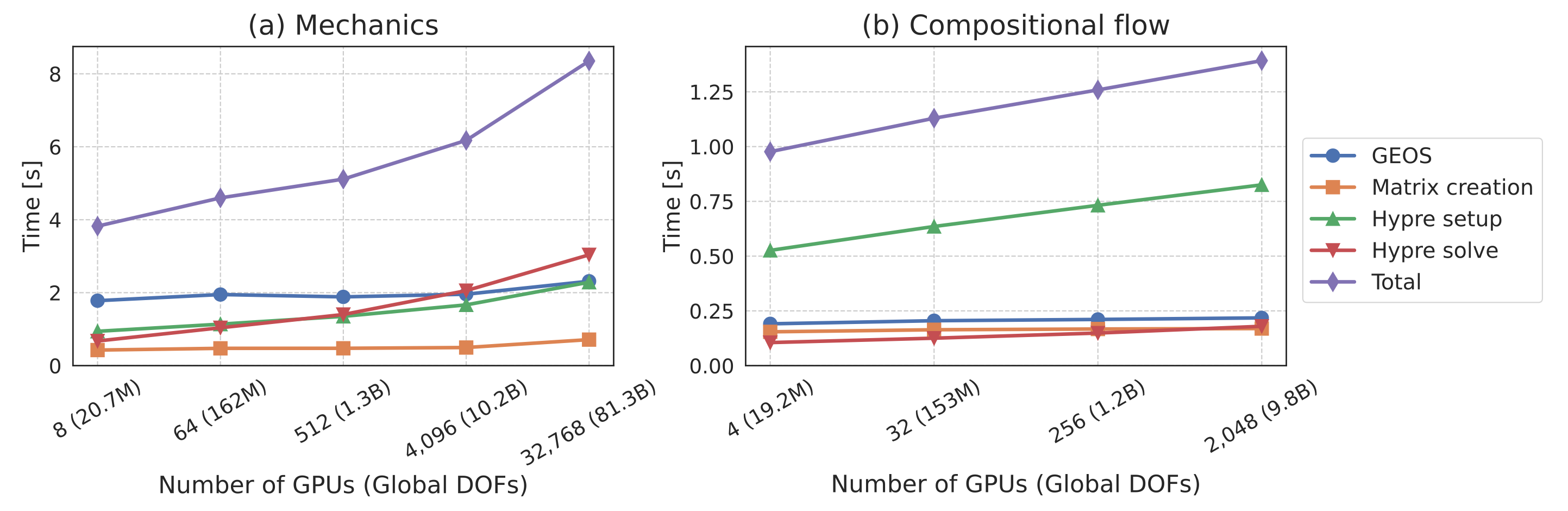
GEOS is built from the ground up for modern HPC hardware. The core simulation engine supports GPU acceleration (CUDA, HIP) and massively parallel execution via MPI, enabling simulations on leadership-class supercomputers. This performance is not an afterthought layered onto legacy code; the data structures, memory management, and solver interfaces are all designed for heterogeneous computing architectures.
This enables workflows that were previously impractical: large-ensemble uncertainty quantification, high-resolution geomechanical models at field scale, and real-time monitoring applications with digital twins.
Coupled Multiphysics
GEOS provides monolithic, iteratively-coupled, and split approaches to solves flow, transport, thermal, and geomechanical equations within a single framework. Supported physics include:
- Multiphase, multicomponent flow
- Poroelastic and poroplastic geomechanics
- Thermal conduction and convection
- Contact mechanics on faults and fractures
- Fracture mechanics (cohesive zone, virtual crack closure, phase-field, and embedded discrete fracture models)
- Well models
The coupling framework is modular, so users can activate only the physics relevant to their problem, from simple single-phase flow to fully-coupled THM simulations with fracture propagation. New physics capabilities are under continuous development.
Scalable Solvers
Solving these coupled nonlinear systems at very large scale requires specialized algorithms. GEOS implements unique linear and nonlinear solvers tailored to these challenging problems, with close collaboration with the Hypre development team. The solver infrastructure supports:
- Algebraic Multigrid (AMG) and Multgrid Reduction (MGR) preconditioners
- Multiscale Methods
- Monolithic, Iteratively-Coupled, and Split solver strategies for multiphysics
- Newton and Inexact-Newton solvers with safeguards
These solvers scale to billions of degrees-of-freedom across tens-of-thousands of ranks, and are portable to numerous hardware architectures.
Complex Geology
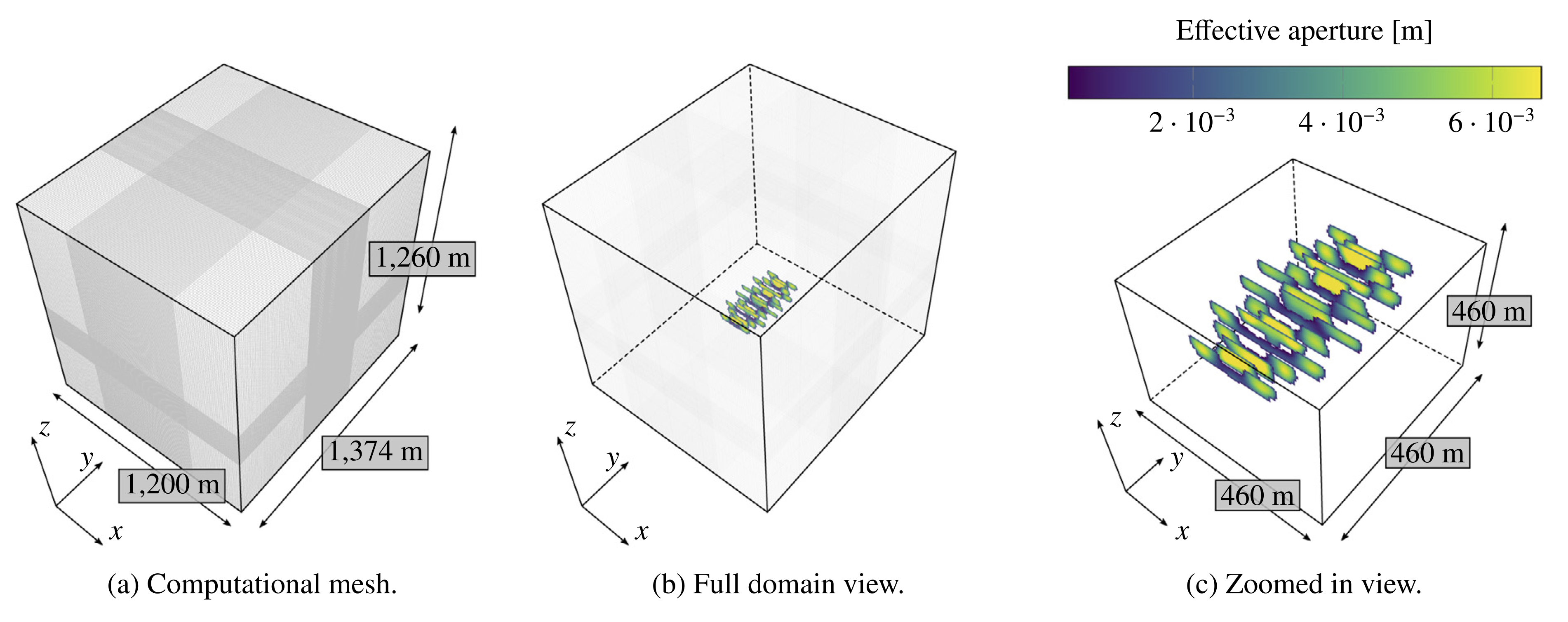
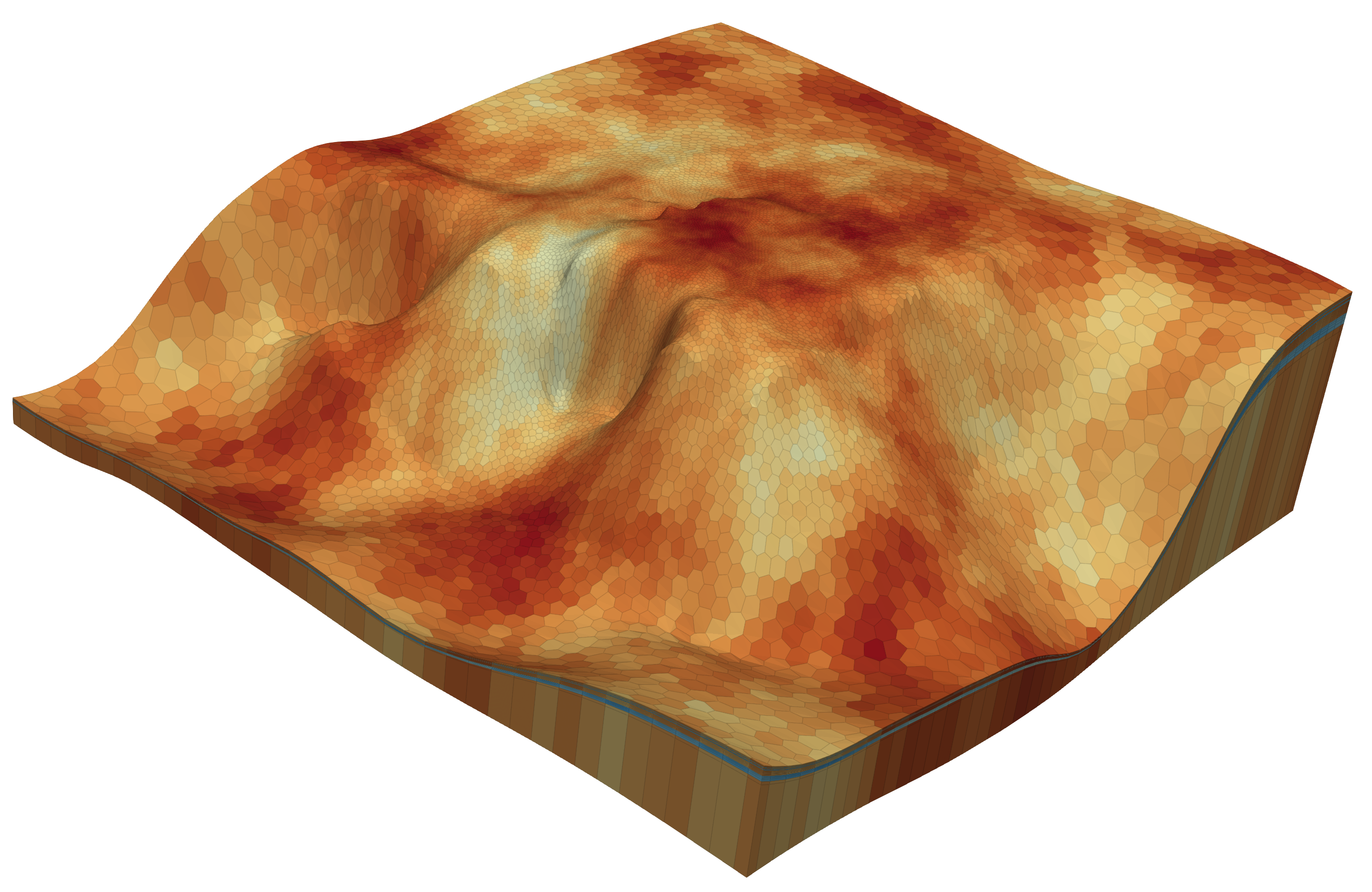
Subsurface models require faithful representation of geologic complexity. GEOS supports unstructured meshes and provides infrastructure for:
- Traditional FEM-meshes with hexes, tets, pyramids, and wedges
- PEBI and polyhedral meshes
- Conforming and non-conforming fault representations
- Embedded discrete fracture models (EDFM)
- Discrete fracture networks (DFN)
- Mesh-dependent and mesh-independent fracture propagation
- Complex well trajectories with multi-segment well models
The mesh infrastructure is tightly integrated with the parallel data management layer, enabling efficient partitioning and load balancing for complex geologic models.
Open Source and Extensible
GEOS is released under the LGPL-2.1 license and developed openly on GitHub. The modular, object-oriented C++ architecture is designed for extensibility. Researchers can implement new constitutive models, solvers, or physics modules without modifying the core framework. A comprehensive documentation and testing infrastructure supports community contributions and reproducible research.